
Sustainability in the office furniture industry is no longer something that we need to just be thinking about – it’s something that we need to be doing.
Living within a generation of mass consumption, we need to force ourselves to consider the impact of our purchasing decisions on our environment.
The Design Council’s 2002 Annual Review found that 80% of a product’s environmental impact is determined at the design stage — highlighting both the need and importance for early intervention.
The office furniture industry is underpinned by creatives. Designers and manufacturers pushing the boundaries of what’s possible and challenging conventional norms, all while considering the wider sustainability ramifications. In our latest blog, we pick out some of our favourite examples of sustainable products and design practices within our industry:
HÅG Capisco Puls from Flokk
Norwegian manufacturers Flokk have turned the phrase “if it isn’t broken, don’t fix it” on its head – taking broken snowplough markers and turning them into one of the most iconic silhouettes of the office furniture industry – the HÅG Capisco.
In 2021, Ivar Opås, General Manager of Norway’s largest snowplough producer, read an article about Flokk’s use of recycled snowplough markers in a limited-edition chair. Seeing a perfect opportunity for collaboration, he reached out to Flokk. At the same time, Kjell Bjørn Vinje of The Norwegian Public Roads Administration also recognized the potential of this sustainable innovation. The three parties soon joined forces to create a long-term solution. Both Vinje and Opås needed a more sustainable way to dispose of damaged snowplough markers, and Flokk needed a steady supply of recycled materials – something they’d previously struggled to find.
Of the 600 tonnes of plastic produced each year for snowplough markers, around 180 tonnes are damaged beyond repair by Norway’s harsh winters. Flokk now transforms this waste into the iconic HÅG Capisco Puls — breaking the raw material into small chips of plastic which are then turned into chair components, without any virgin plastic, making it 100% recycled. With 7.5 tonnes of damaged plastic, Flokk are able to produce nearly 3,000 chairs.
As there’s differentiations of snowplough marker colours, each batch of chairs that Flokk creates has a variation of colour – further adding to the uniqueness of what’s an already venerated office chair.
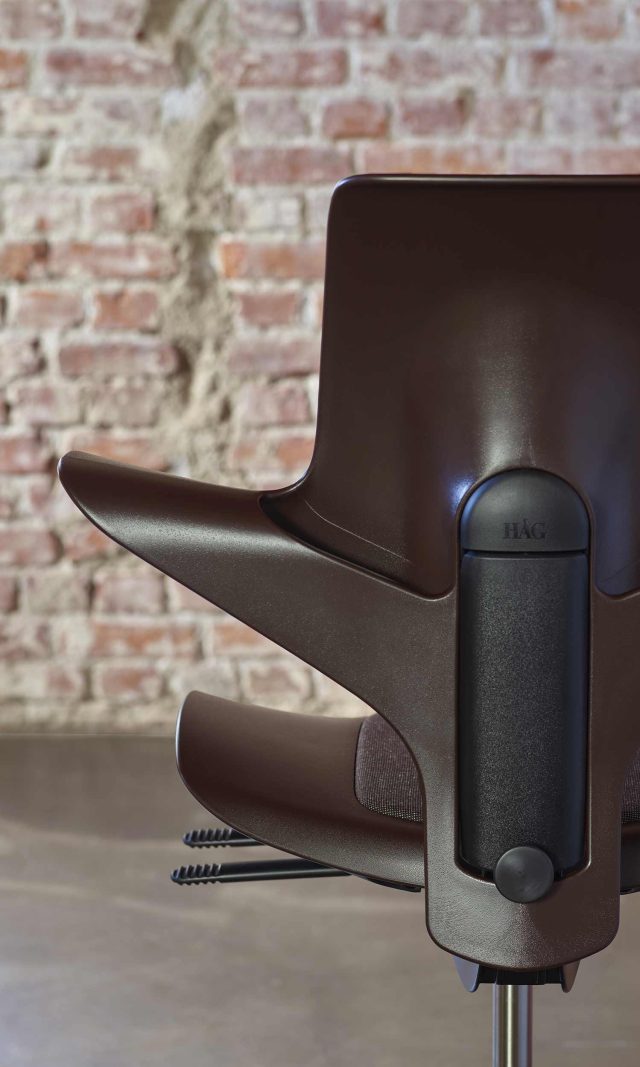
HÅG Capisco Puls. Image Credit – Flokk.
Hemp Fine from Vepa
Dubbed ‘the most sustainable chair ever’, the Hemp Fine by Dutch brand Vepa is the world’s first 100% plant-based chair – with a shell made entirely out of hemp and plant-based resin.
Grown in a Greenfield behind Vepa’s factory in Emmen, hemp is sewn, cut and laid out to dry for two weeks before being made into bales for processing.
The fibres are combed and pressed into mats resembling rolls of carpet. For this mat to be used to make a chair, a binding agent is required. Given the emphasis on sustainability, Vepa only use a recyclable and biodegradable binder – otherwise it’s not an option. Extensive testing from Vepa resulted in the creation of an organic glue made from only natural materials.
The mat is treated with this bio-resin, placed into a mould and the result is a chair shell, free from formaldehyde and with a negative CO2 footprint.
Once your chair comes to the end of its life, Vepa want it back. Although the chair is entirely biodegradable, Vepa can use the entirety of the chair for parts, shredding it down and using this ‘waste’ to create the chair all over again – ensuring an entirely circular life cycle.
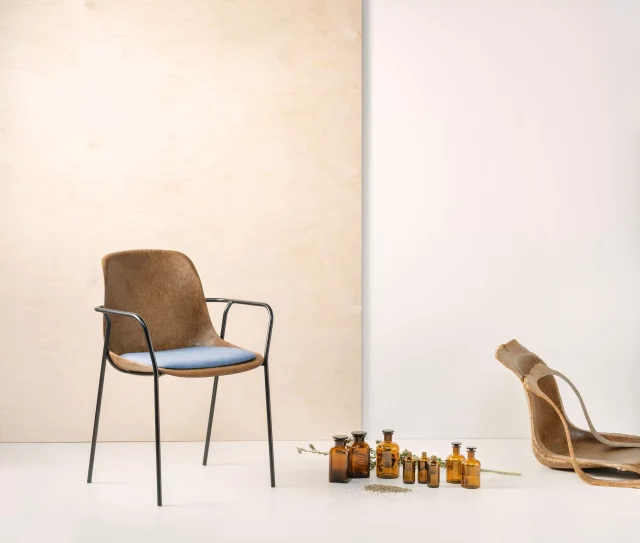
Hemp Fine. Image Credit – Vepa.
Fabric Sustainability from Camira
The fabric specialists Camira are no strangers to sustainability in their practices. Back in 1996, when it was largely unheard of, they adopted the environmental management system ISO14001. Sustainability is something that they’ve never forgotten.
In collaboration with SEAQUAL INITIATIVE, Camira were able to create two distinct fabric lines designed to combat marine plastic pollution.
Oceanic, the inaugural fabric of the collection, is woven from plastic debris found in our seas and beaches and from post-consumer plastic bottles destined for landfill. Woven using SEAQUAL® YARN, for every 4 metres of Oceanic fabric sold, 1kg of waste is removed from the ocean.
Available in 27 colourways, the elegant and evocative Quest, a continuation of the collaboration, is their new fabric woven entirely from recycled ocean-waste plastic. Each metre of Quest contains the equivalent of 23 plastic bottles. Not only this, but Camira make a donation for each metre of Quest sold directly to the SEAQUAL INITIATIVE – further supporting their effort in cleaning up our oceans.
This process creates a beautiful and intricate twill weave fabric, coming with a 10 year warranty, that is suitable for a range of uses from task seating to soft seating and panelling.

Oceanic. Image Credit – Camira.
Sustain from The Senator Group
In 2009, The Senator Group developed a £1.5million facility called ‘Sustain’ – a facility designed to embed sustainability in every aspect of their business.
Fast forward 17 years, and Senator are at the forefront of recycling practices on their journey to net zero.
As a manufacturer, their ability to start the process of creating office furniture with reduce in mind is unrivalled.
With their furniture recycling capability, Senator are able to offer an end-of-life service for office furniture. Upon receiving an item, they’re able to break this down into separate components such as plastic, wood, metal, foam and textiles – ensuring no waste goes to landfill. Showing a wider commitment to the environment, they’ll recycle as much of their competitors components as possible too. To minimise the use of virgin materials, they can also remanufacture every product within their product line, as well as their competitors.
If you’ve ever received a delivery of office furniture, you’ll be aware at the level of packaging involved. All waste packaging can be sent to Sustain for recycling. Again, their programme covers their own waste packaging and that of their competitors. Taking that commitment one step further, dealers, suppliers and contractors are all encouraged to use their Waste Packaging facility. In 2020, this scheme was so successful that they saw 8,635 bags of packaging recycled.
Since 2019, Sustain’s commitment to the environment has resulted in 750,000 items of furniture being diverted from landfill, and they’ve recycled over 50 million kg of materials.
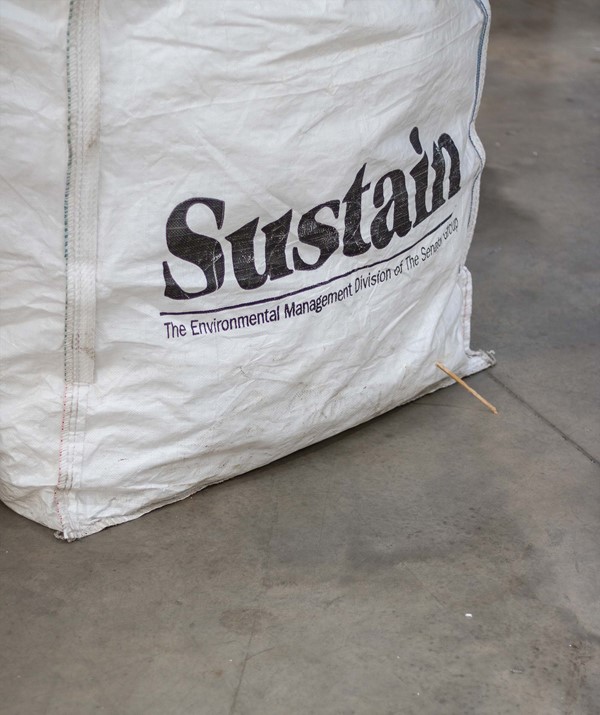
Sustain. Image Credit – The Senator Group.
If you’re looking for sustainable office furniture for your commercial space, we’d love to hear from you. You can get in touch with us here – we’d be more than happy to discuss your requirements and see how we can help support your journey towards a greener, more sustainable workspace.